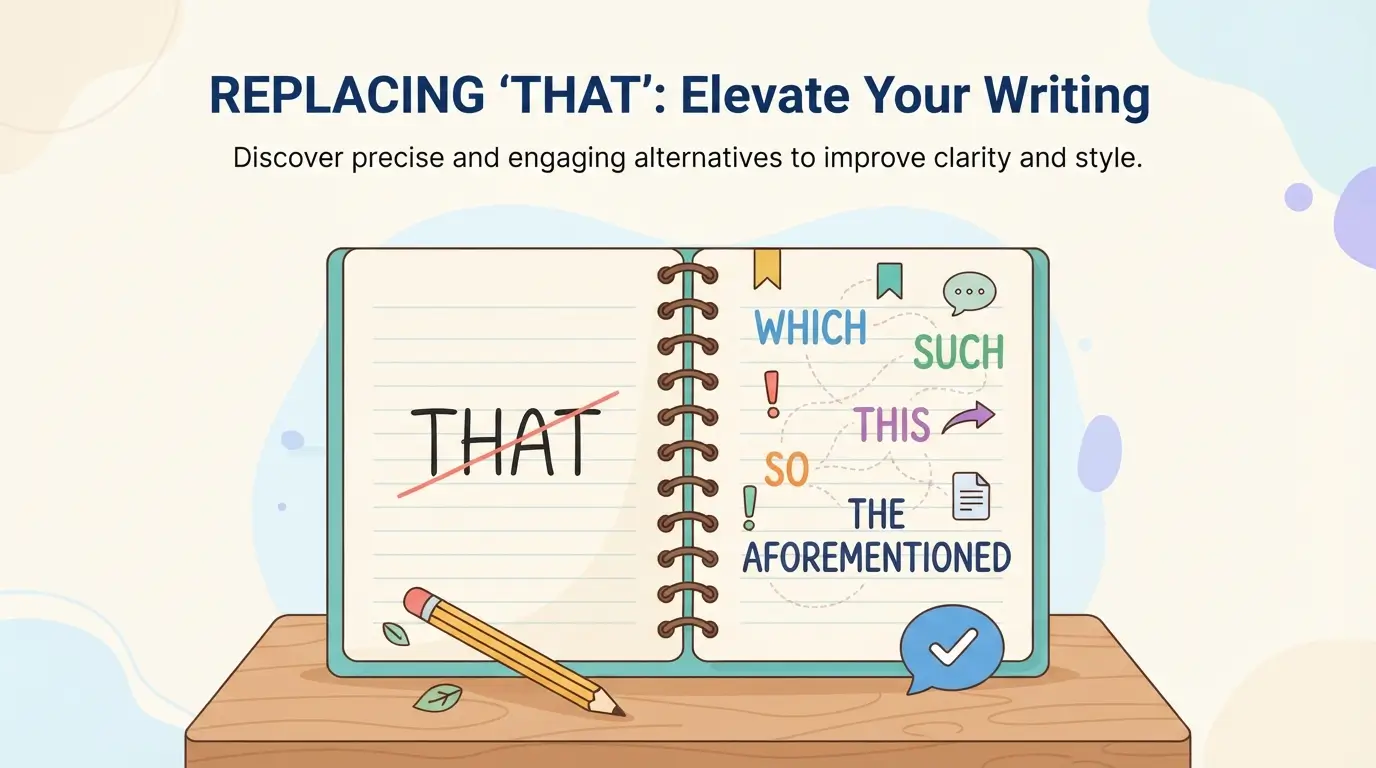
A synonym for “that” is any word that points to something, links two ideas, or adds emphasis in a sentence, such as “this,” “which,” “so,” “such,” or “the said.” These words let you replace “that” without changing your meaning, making your writing sound clearer, smoother, and less repetitive.
Picture this: you are writing an email to your boss, and the word “that” shows up in almost every sentence. It feels stuck and repetitive. A quick fix turns a flat message into a sharp one. Instead of “I know that you are busy,” try “I know you are busy.”
This tiny word carries a big job. For students, synonyms build stronger essays. For bloggers, they keep posts fresh. All content writers, they boost SEO. For daily English users, they make speech sound natural.
“Words are, of course, the most powerful drug used by mankind.” — Rudyard Kipling
Small word swaps like these are a fast way to grow your vocabulary without any extra effort.
“The limits of my language mean the limits of my world.” — Ludwig Wittgenstein
The 50 Synonyms List
1. This
- Meaning: A word used to point to something close or already mentioned.
- Examples: This is the report you asked for. This plan will work fine.
2. Such
- Meaning: Describes a thing of a certain kind or amount.
- Examples: Such behavior is not allowed here. I never expected such a gift.
3. So
- Meaning: A word used to show a result or a strong degree.
- Examples: She was so tired yesterday. He ran so fast home.
4. It
- Meaning: A short word used to stand in for a thing already named.
- Examples: I finished it before lunch. She loved it a lot.
5. Which
- Meaning: A word used to add extra information about something already named.
- Examples: The car, which was new, broke down. My phone, which is old, still works.
6. Who
- Meaning: A word used to link a person to more information about them.
- Examples: The teacher who helped me left early. My friend who called is kind.
7. Whom
- Meaning: A formal word used to refer to a person receiving an action.
- Examples: The man whom I met was polite. The guest whom we invited arrived late.
8. The Aforementioned
- Meaning: A formal phrase meaning the thing mentioned earlier in the text.
- Examples: The aforementioned rule applies here too. Please review the aforementioned document again.
9. The Said
- Meaning: A legal or formal way to point back to something already named.
- Examples: The said contract expires soon. The said amount was paid fully.
10. The One
- Meaning: A phrase pointing to a specific, known item.
- Examples: I want the one you showed me. She picked the one near the door.
11. Yon
- Meaning: An old-fashioned word meaning something far away in sight.
- Examples: Yon hill looks steep today. Yon house has stood for years.
12. Yonder
- Meaning: A poetic word meaning something visible but distant from the speaker.
- Examples: Look at yonder mountain range. Yonder field is full of flowers.
13. The Above-Mentioned
- Meaning: A formal phrase pointing back to something written earlier in a document.
- Examples: The above-mentioned policy starts Monday. Please sign the above-mentioned form today.
14. The Latter
- Meaning: A word pointing to the second of two things already named.
- Examples: Of the two jobs, I chose the latter. The latter option seems safer.
15. The Former
- Meaning: A word pointing to the first of two things already named.
- Examples: The former plan was cheaper overall. I preferred the former idea instead.
16. Aforesaid
- Meaning: A formal word meaning something already stated before in writing.
- Examples: The aforesaid terms remain unchanged. The aforesaid witness signed the papers.
17. In Question
- Meaning: A phrase describing the exact thing being discussed right now.
- Examples: The item in question is missing. The policy in question needs updating.
18. The Very
- Meaning: A phrase used to stress the exact same thing already mentioned.
- Examples: This is the very book I lost. He wore the very shirt again.
19. So Much
- Meaning: A phrase used to show a strong or large degree of something.
- Examples: She loves him so much. I missed home so much.
20. To Such An Extent
- Meaning: A phrase showing how far something has grown.
- Examples: He worked to such an extent he collapsed. Prices rose to such an extent quickly.
21. So That
- Meaning: A phrase used to explain the purpose or reason behind an action.
- Examples: She saved money so that she could travel. Study hard so that you pass.
22. In Order That
- Meaning: A formal phrase used to explain the purpose of an action.
- Examples: He left early in order that he arrive on time. We planned in order that nothing failed.
23. Given That
- Meaning: Introduces a fact you rely on.
- Examples: Given that it’s raining, bring an umbrella. Given that he’s late, start without him.
24. Considering That
- Meaning: Used when weighing a fact before deciding.
- Examples: Considering that it’s cold, wear a coat. Considering that she’s new, be patient.
25. Seeing That
- Meaning: A casual phrase used to explain a reason based on a fact.
- Examples: Seeing that you’re free, let’s talk now. Seeing that it’s late, head home.
26. Because
- Meaning: A word used to explain the reason for something happening.
- Examples: She smiled because she was happy. He left because it got late.
27. Since
- Meaning: A word used to give a reason, often in a casual tone.
- Examples: Since you’re here, let’s start. Since it’s sunny, go outside.
28. As
- Meaning: A word used to link a reason or a time to an action.
- Examples: As it rained, we stayed inside. As she smiled, everyone relaxed.
29. For The Reason That
- Meaning: Used to formally state why something is true.
- Examples: He resigned for the reason that he retired. She left for the reason that stated.
30. Due To The Fact That
- Meaning: Used to explain the exact cause of something.
- Examples: The trip was canceled due to the fact that it snowed. He was late due to heavy traffic.
31. Owing To The Fact That
- Meaning: A formal phrase explaining a cause in reports.
- Examples: Sales dropped owing to the fact that prices rose. He failed owing to missed classes.
32. Whereas
- Meaning: A formal word used to compare two different facts or ideas.
- Examples: She likes tea, whereas he prefers coffee. I stayed home, whereas they traveled far.
33. Insofar As
- Meaning: A formal phrase meaning to a certain degree.
- Examples: Insofar as I know, he’s honest. Insofar as it helps, use it.
34. To The Extent That
- Meaning: Shows how much something is true or happened.
- Examples: He helped to the extent that he could. She saved to the extent that mattered.
35. Provided That
- Meaning: Means something happens only if a condition is met.
- Examples: You can go, provided that you finish. We’ll succeed provided that we plan.
36. Assuming That
- Meaning: Used to guess something without full proof yet.
- Examples: Assuming that it’s true, we should act. Assuming that he comes, we’ll wait.
37. So As To
- Meaning: Used to explain the purpose behind an action.
- Examples: She left early so as to avoid traffic. He studied so as to pass.
38. Such That
- Meaning: Shows a result strong enough to cause an effect.
- Examples: It rained such that streets flooded quickly. He shouted such that everyone heard.
39. The Specific
- Meaning: A phrase pointing to one exact thing among several similar options.
- Examples: I need the specific file you sent. She wants the specific color shown.
40. The Particular
- Meaning: A phrase pointing to one distinct thing rather than a general group.
- Examples: The particular reason wasn’t shared. He liked the particular design best.
41. The Exact
- Meaning: A phrase pointing to something precise, with no room for error.
- Examples: Give me the exact number please. She wore the exact outfit twice.
42. The Precise
- Meaning: A formal phrase describing something stated with great accuracy or detail.
- Examples: We need the precise time now. He gave the precise location quickly.
43. The Certain
- Meaning: A phrase referring to a specific but sometimes unnamed thing or person.
- Examples: A certain person told me this. There’s a certain charm about it.
44. The Given
- Meaning: A phrase pointing to information already provided or known beforehand.
- Examples: Based on the given data, plan ahead. The given rules must be followed.
45. The Mentioned
- Meaning: A phrase pointing to something already brought up earlier in speech.
- Examples: The mentioned issue is now fixed. Please review the mentioned points again.
46. The Stated
- Meaning: A formal phrase pointing to something clearly written or spoken already.
- Examples: Follow the stated instructions closely. The stated price includes tax already.
47. The Referenced
- Meaning: A formal phrase pointing to something cited earlier in a document.
- Examples: Check the referenced page for details. The referenced study supports this claim.
48. The Noted
- Meaning: A phrase pointing to something already recorded or written down before.
- Examples: The noted changes look great. Please address the noted concerns soon.
49. The Cited
- Meaning: A formal phrase pointing to a source already mentioned in writing.
- Examples: The cited article backs this idea. Check the cited source for proof.
50. The Indicated
- Meaning: A phrase pointing to something already shown or pointed out clearly.
- Examples: Sign at the indicated line below. Follow the indicated path ahead.
Synonyms for That Said
“That said” is a transition phrase. Good swaps include “having said this,” “with that in mind,” or “still.” These fit best at the start of a sentence when adding a new point without sounding repetitive, especially in essays and formal emails.
Synonyms for That Reason
Cause-and-effect swaps for “that reason” include “for this cause,” “on this basis,” or “consequently.” These reduce repetition in essays and reports while clearly linking a reason to its result in academic or workplace writing.
Synonyms for That’s Great
For a casual, upbeat reply, try “awesome,” “fantastic,” “wonderful,” or “brilliant” instead of “that’s great.” These keep chats and texts warm and friendly without sounding repeated or flat.
Synonyms for That’s Crazy
To react to something surprising, use “that’s wild,” “no way,” “unbelievable,” or “insane.” These show shock in daily chats and social posts, but fit best in relaxed, informal settings only.
Synonyms for That’s Right
To confirm something, try “exactly,” “correct,” “you got it,” or “precisely.” These show clear agreement in daily talk, workplace check-ins, and quick replies.
FAQs About Synonyms for That
What is a better word for that? It depends on tone. For a formal essay, try “which,” “such,” or “the aforementioned.” For casual speech, “this” or “it” works fine. Formal writing needs sharper words, while daily talk allows simpler, shorter swaps that still sound natural.
What words can I use instead of that? In writing, good choices include “which,” “the said,” “the stated,” or “the given,” especially in reports and essays. These reduce repetition while staying formal. Choose based on whether you are naming a person, fact, or object mentioned earlier.
What can we use instead of that? In speech, simple swaps work best, like “this,” “so,” “it,” or “such.” These keep sentences short and natural when talking to friends, family, or coworkers. Save formal words like “aforementioned” for essays or reports instead.
What’s another word for saying that? When reporting speech, try “stated,” “mentioned,” “noted,” or “claimed” instead of “said that.” These verbs sound more professional and less repetitive in articles and essays, and each one also hints at a slightly different tone.
Another Word for That in an Essay
Strong essay swaps: “which,” “such,” “the aforementioned.”
- “Which” adds extra detail
- “Such” names a type
- “The aforementioned” suits formal review
That Synonym Formal
Formal swaps: “the said,” “the stated,” “the aforementioned.”
- “The said” fits legal text
- “The stated” fits reports
- “The aforementioned” fits essays
Another Word for Saying That
Speech swaps: “stated,” “mentioned,” “expressed.”
- “Stated” sounds neutral
- “Mentioned” sounds casual
- “Expressed” sounds personal
That’s Why Synonyms Formal
Formal swaps for “that’s why”: “therefore,” “hence,” “consequently.”
- “Therefore” suits essays
- “Hence” suits arguments
- “Consequently” suits cause-effect writing
That Meaning In
“That” usually points to something already named nearby.
- Points to a thing
- Points to a person
- Points to an idea
That Can Synonym
Swaps for “that can”: “which may,” “that could,” “which is able to.”
- “Which may” fits formal writing
- “That could” fits casual speech
- “Which is able to” fits reports
That You Synonym
Swaps for “that you”: “which you,” “whom you,” or drop it entirely.
- “Which you” fits essays
- “Whom you” fits polite writing
- Dropping “that” fits daily talk
That Will Synonym
Swaps for “that will”: “which will,” “that shall,” “which is going to.”
- “Which will” fits formal writing
- “That shall” fits legal tone
- “Which is going to” fits casual talk
| Keyword | Meaning | Usage Type | Context |
| Another word for that in an essay | Formal swaps for “that” in academic text | Formal | School, essays |
| That synonym formal | Stiff, professional replacements for “that” | Formal | Contracts, reports |
| Another word for saying that | Verbs replacing “saying that” | Professional | Articles, interviews |
| That’s why synonyms formal | Formal cause-effect connectors | Formal | Essays, arguments |
| That meaning in | Explains what “that” points to | Neutral | Grammar learning |
| That can synonym | Swaps for “that can” | Casual/Formal | Daily speech, writing |
| That you synonym | Swaps for “that you” | Formal | Polite writing |
| That will synonym | Swaps for “that will” | Formal | Legal, business tone |
Conclusion
Learning synonyms for small words like “that” makes a big difference. It sharpens your writing, improves your blogging, and helps your speaking sound natural. Once you notice how often “that” repeats, swapping in “which,” “such,” or “the aforementioned” becomes second nature.
Try these words in your next email, essay, or daily chat. Small changes add up fast, and readers notice smoother writing right away.
“To gain a good reputation, endeavor to be what you desire to appear.” — Socrates
Keep a short list of your favorite synonyms nearby while writing. Over time, your vocabulary will grow naturally, and your sentences will sound clearer, stronger, and more confident.
“The difference between the almost right word and the right word is really a large matter.” Mark Twain
Start small, stay consistent, and let your writing grow one word at a time.

Daniel Parker is a tech researcher and contributor at Synulo.com, providing easy-to-understand guides on software, AI tools, and online resources.