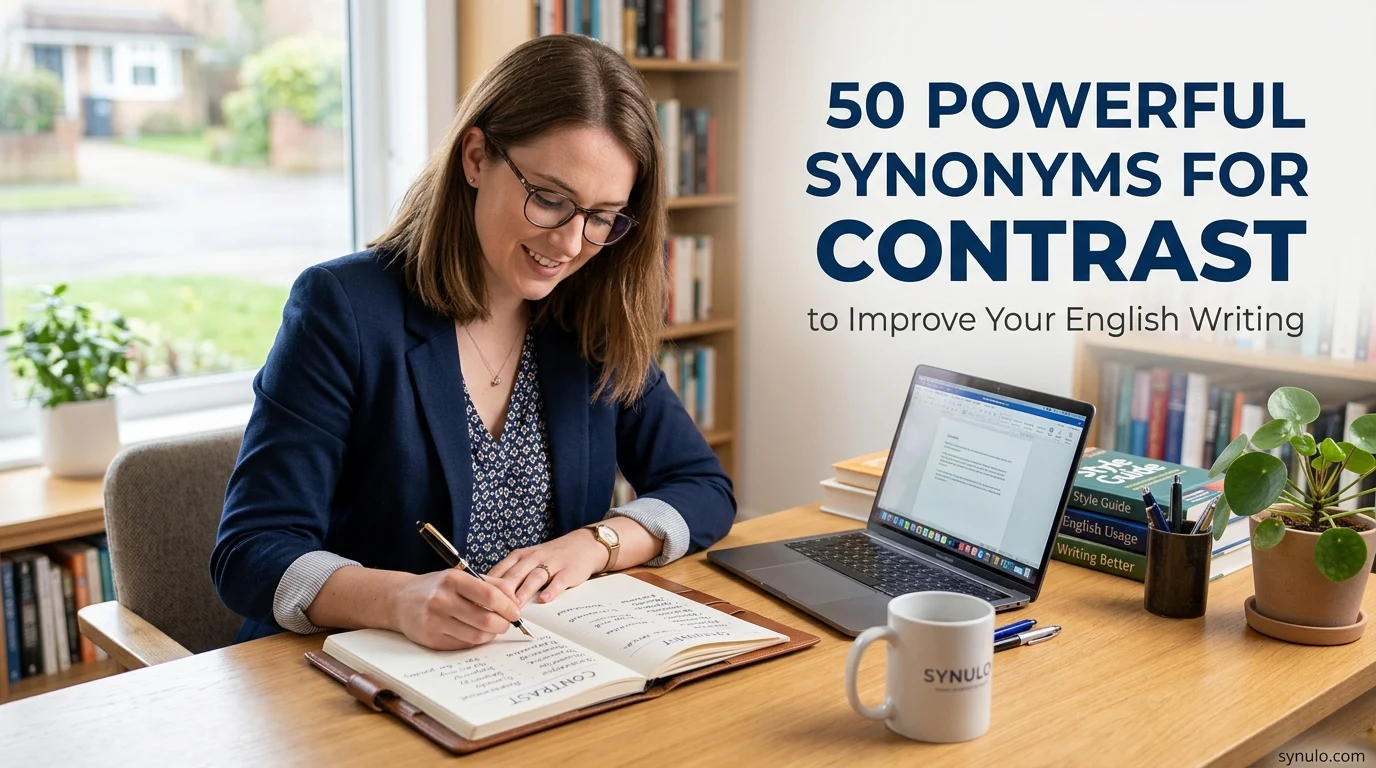
Synonyms for contrast are words that have a similar meaning to contrast. Synonyms for contrast help you show differences between ideas, people, objects, or situations. Learning synonyms for contrast makes your English clearer and more interesting.
Imagine writing an essay where every sentence uses only the word “contrast.” The meaning is correct, but the writing may feel boring. A student comparing two books, a blogger explaining two products, or a writer sharing two opposite views needs more word choices. This is where synonyms become useful.
In simple English, contrast means to show how two things are different. For example, “The bright room contrasts with the dark hallway.” It tells us that the two places are not the same.
Learning synonyms for contrast helps students write better essays, bloggers create engaging articles, content writers avoid repetition, and daily English users express ideas more naturally.
Good vocabulary is like a toolbox. The more words you know, the easier it becomes to choose the right one for every situation.
“A strong vocabulary gives your ideas a clearer voice.”
“Small word choices can create a big difference in communication.”
No additional keywords were provided for this article.
Comparison Table
| Keyword | Meaning | Usage Type (formal/casual/emotional/professional) | Context (relationship, workplace, daily use, etc.) |
|---|---|---|---|
| No additional keyword | No extra keyword was provided | Not applicable | Not applicable |
1. Difference
Meaning: Difference means the way two things are not the same.
Examples:
- I can see a big difference between these two phones.
- The difference between summer and winter is clear.
2. Distinction
Meaning: Distinction means a clear difference between things.
Examples:
- There is a distinction between facts and opinions.
- She explained the distinction very well.
3. Variation
Meaning: Variation means a small or large change between things.
Examples:
- There is a variation in the prices of these products.
- The colors show a nice variation.
4. Comparison
Meaning: Comparison means looking at two things to find similarities or differences.
Examples:
- The comparison helped me choose a better option.
- I made a comparison between two laptops.
5. Opposite
Meaning: Opposite means completely different from something else.
Examples:
- Black is the opposite of white.
- Their opinions are opposite.
6. Difference
Meaning: Difference shows how things are separate or unlike.
Examples:
- The difference is easy to notice.
- I found a difference in the two answers.
7. Disagreement
Meaning: Disagreement means people have different opinions.
Examples:
- We had a disagreement about the plan.
- Their disagreement lasted for days.
8. Conflict
Meaning: Conflict means a strong difference between ideas or people.
Examples:
- The story shows conflict between two families.
- There was conflict in the workplace.
9. Divergence
Meaning: Divergence means moving or becoming different.
Examples:
- Their ideas showed a clear divergence.
- The paths began to show divergence.
10. Separation
Meaning: Separation means keeping two things apart.
Examples:
- The wall creates a separation between rooms.
- There is a separation between work and home life.
11. Distancing
Meaning: Distancing means creating space or difference.
Examples:
- He is distancing himself from the old habits.
- The design creates distancing between sections.
12. Disparity
Meaning: Disparity means a noticeable difference, often in amount or quality.
Examples:
- There is a disparity between the two results.
- The report shows a disparity in income.
13. Inequality
Meaning: Inequality means an unfair difference between people or things.
Examples:
- The topic discusses inequality in society.
- They want to reduce inequality.
14. Imbalance
Meaning: Imbalance means a lack of equal balance.
Examples:
- There is an imbalance between work and rest.
- The system has an imbalance.
15. Gap
Meaning: Gap means a space or difference between two things.
Examples:
- There is a gap between their opinions.
- The skill gap is growing.
16. Variety
Meaning: Variety means having different types of things.
Examples:
- The store offers a variety of choices.
- I enjoy the variety of food here.
17. Diversity
Meaning: Diversity means having many different types or forms.
Examples:
- The team has great diversity.
- Diversity makes ideas stronger.
18. Change
Meaning: Change means becoming different from before.
Examples:
- The weather change was sudden.
- I noticed a change in his attitude.
19. Shift
Meaning: Shift means a movement from one state to another.
Examples:
- There was a shift in public opinion.
- The company made a shift in strategy.
20. Turnaround

Meaning: Turnaround means a complete change in direction.
Examples:
- The business had a quick turnaround.
- His attitude showed a turnaround.
21. Opposing View
Meaning: Opposing view means an idea that is different from another idea.
Examples:
- She shared an opposing view.
- We listened to opposing views.
22. Counterpoint
Meaning: Counterpoint means an idea that shows another side.
Examples:
- The article presents a useful counterpoint.
- His comment was a good counterpoint.
23. Antithesis
Meaning: Antithesis means a strong opposite idea.
Examples:
- The speech used antithesis effectively.
- The writer created antithesis between hope and fear.
24. Variation
Meaning: Variation means a difference in form or style.
Examples:
- This recipe has a small variation.
- The design has many variations.
25. Discrepancy
Meaning: Discrepancy means a difference between expected and actual results.
Examples:
- We found a discrepancy in the report.
- The numbers show a discrepancy.
26. Distortion
Meaning: Distortion means a change that makes something different.
Examples:
- The image has some distortion.
- The message suffered distortion.
27. Opposition
Meaning: Opposition means being against something.
Examples:
- The idea faced strong opposition.
- They showed opposition to the rule.
28. Contrast
Meaning: Contrast means showing how things are different.
Examples:
- The colors create a beautiful contrast.
- The article shows contrast between two views.
29. Discrimination
Meaning: Discrimination means noticing or treating things differently.
Examples:
- The test measures discrimination between sounds.
- Good discrimination helps decision-making.
30. Separation
Meaning: Separation means a clear space between two things.
Examples:
- The separation is easy to see.
- The rooms have a natural separation.
31. Distinctness
Meaning: Distinctness means being clearly different.
Examples:
- The colors have distinctness.
- Her voice has unique distinctness.
32. Unlikeness
Meaning: Unlikeness means not being similar.
Examples:
- The unlikeness between them is clear.
- I noticed the unlikeness in their styles.
33. Oppositeness
Meaning: Oppositeness means being completely different.
Examples:
- Their choices show oppositeness.
- The story uses oppositeness for effect.
34. Clashing
Meaning: Clashing means strongly different or conflicting.
Examples:
- The colors are clashing.
- Their ideas are clashing.
35. Inconsistency
Meaning: Inconsistency means a lack of agreement.
Examples:
- The report has an inconsistency.
- I noticed inconsistency in his answers.
36. Disconnection
Meaning: Disconnection means a lack of connection.
Examples:
- There is a disconnection between the teams.
- The idea shows disconnection.
37. Separation Line
Meaning: Separation line means a point that divides two things.
Examples:
- The border acts as a separation line.
- The design has a separation line.
38. Distinguishment
Meaning: Distinguishment means showing something as different.
Examples:
- The award gives him distinguishment.
- The feature creates distinguishment.
39. Alternate
Meaning: Alternate means different from another option.
Examples:
- We chose an alternate route.
- She gave an alternate answer.
40. Contrary

Meaning: Contrary means opposite or different.
Examples:
- His actions were contrary to his words.
- The result was contrary to expectations.
41. Reversal
Meaning: Reversal means a complete change to the opposite.
Examples:
- The decision was a reversal.
- The trend showed a reversal.
42. Difference Point
Meaning: Difference point means a place where things separate.
Examples:
- The difference point is easy to find.
- We discussed the difference point.
43. Comparison Point
Meaning: Comparison point means a feature used to compare things.
Examples:
- Price is a comparison point.
- Quality became the main comparison point.
44. Divide
Meaning: Divide means to separate into different parts.
Examples:
- The wall divides the room.
- The topic divides people.
45. Split
Meaning: Split means to separate into parts.
Examples:
- The group had a split opinion.
- The road creates a split.
46. Break
Meaning: Break means a separation or change.
Examples:
- There was a break in their friendship.
- The pattern has a sudden break.
47. Variation Point
Meaning: Variation point means a place where differences appear.
Examples:
- The variation point is important.
- We studied the variation point.
48. Differentiate
Meaning: Differentiate means to show how things are different.
Examples:
- This feature helps differentiate products.
- We need to differentiate the two ideas.
49. Compare
Meaning: Compare means to examine things for similarities and differences.
Examples:
- I compare prices before buying.
- Teachers compare student progress.
50. Distinguish
Meaning: Distinguish means to recognize differences.
Examples:
- I can distinguish the two sounds.
- She can distinguish good ideas quickly.
“The right word can turn a simple sentence into a powerful message.”
Conclusion
Learning synonyms for contrast is a simple way to improve your English skills. When you know more words, your writing becomes smoother, your blogging becomes more engaging, and your speaking becomes more natural.
Using different words instead of repeating “contrast” helps readers understand your ideas better. Students can use these words in essays and assignments. Bloggers and content writers can create stronger articles with better vocabulary. Daily English users can explain opinions, stories, and experiences with more confidence.
Practice these words in your emails, essays, and daily conversations. Start with a few words and slowly add more to your vocabulary. The goal is not to memorize every word at once. The goal is to understand each word and use it in the right situation

Aksone fackts is a technology writer at Synulo.com, covering AI tools, software reviews, and digital solutions to help readers stay ahead in the modern tech world.